130
130
To support the implementation of refined and preventive equipment integrity management at a gas purification plant in Southwest China, accurately identify hidden defects inside heat exchanger tube bundles, mitigate risks such as corrosion leakage and abnormal operating conditions, and ensure the safe, stable, and long-term operation of natural gas purification facilities, T-ALL Inspection's NDT team was recently commissioned to conduct a specialized Remote Field Eddy Current Testing (RFT) inspection on critical in-service heat exchangers within the plant's sulfur recovery unit. Leveraging professional expertise and standardized inspection procedures, the team provided an accurate assessment of the operating condition of these key heat exchange assets, delivering reliable technical support for maintenance and integrity management decisions.
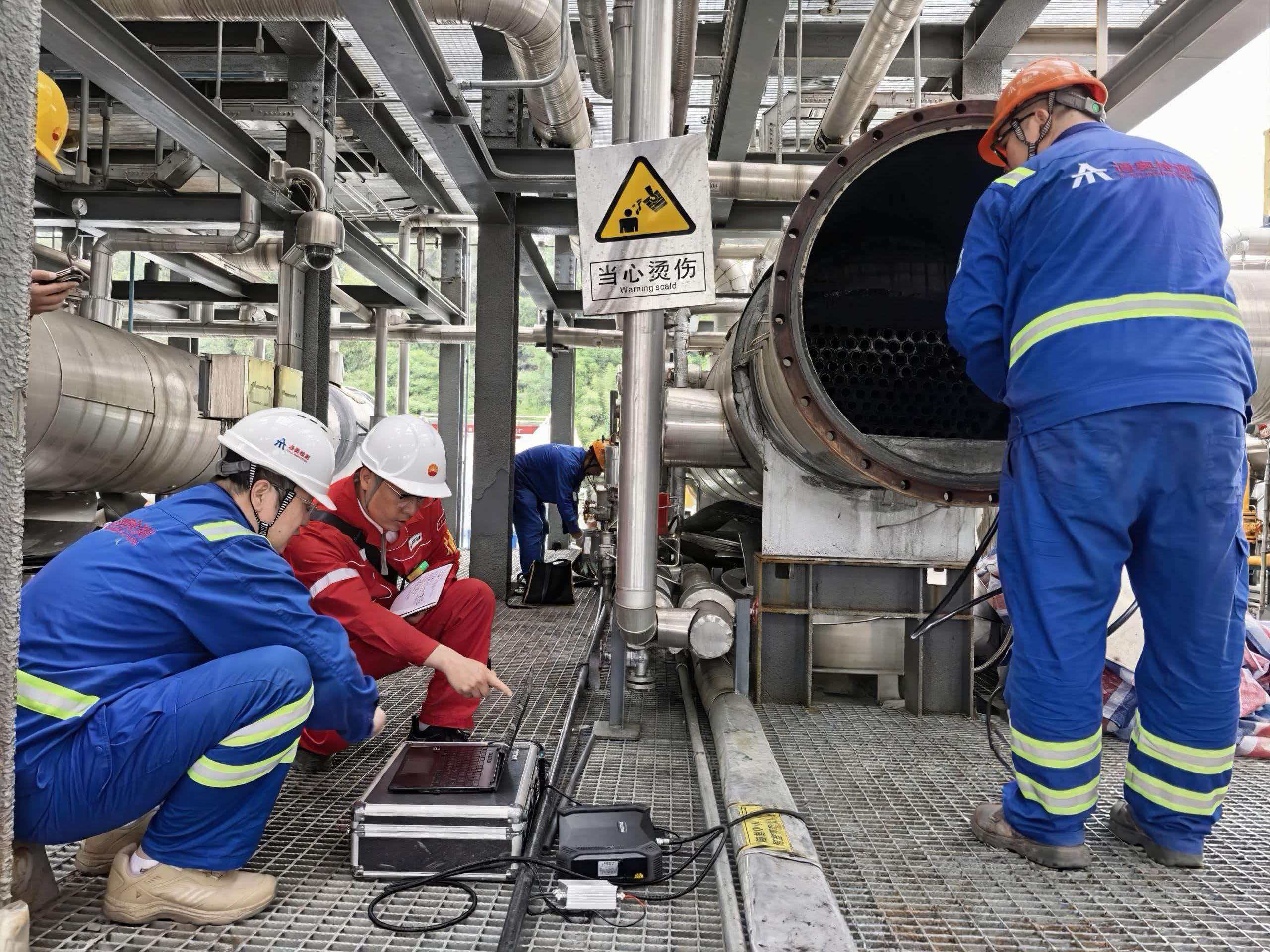
The inspection was carried out in strict accordance with NB/T 47013.6 – Non-destructive Testing of Pressure Equipment: Eddy Current Testing. Considering the operating conditions of carbon steel heat exchanger tubes, where wall thinning, internal corrosion, and external defects are common concerns, the team adopted Remote Field Eddy Current Testing throughout the project.
Unlike conventional eddy current testing, RFT overcomes the limitations of the skin effect by utilizing low-frequency electromagnetic fields that propagate through the tube wall. This enables comprehensive full-wall inspection without blind spots and without the need for magnetic saturation assistance. The technology is capable of accurately detecting corrosion thinning, material loss, cracks, and other types of defects affecting tube integrity.
For all suspected indications identified during the inspection, the team strictly followed a multi-level verification process. Eddy current signal characteristics were repeatedly analyzed, data from multiple inspection points were validated, and cross-checking procedures were conducted to accurately determine defect types, damage severity, and associated risk levels. These measures helped eliminate the risks of missed indications, false calls, and misclassification, ensuring objective, reliable, and trustworthy inspection results.
Following completion of the inspection, the technical team integrated field inspection data with actual operating conditions and categorized findings into three risk levels: general concerns, critical concerns, and out-of-tolerance defects. A comprehensive inspection report, including professional conclusions and targeted recommendations, was provided to the plant, offering authoritative technical support for integrity management and corrective action planning.
Looking ahead, T-ALL Inspection will continue promoting advanced NDT technologies, including Phased Array Ultrasonic Testing (PAUT) for heat exchanger tube-to-tubesheet welds, Pulsed Eddy Current Testing (PECT) for corrosion detection through insulation and protective coatings, and Eddy Current Testing for surface crack detection beneath paint coatings. These technologies help address inspection challenges associated with complex structures, protected equipment, and hidden crack indications.
Through standardized operations, specialized expertise, and precise defect assessment, T-ALL Inspection remains committed to helping clients strengthen asset integrity management throughout the entire equipment lifecycle, ensuring the long-term, safe, stable, and efficient operation of natural gas processing facilities.